
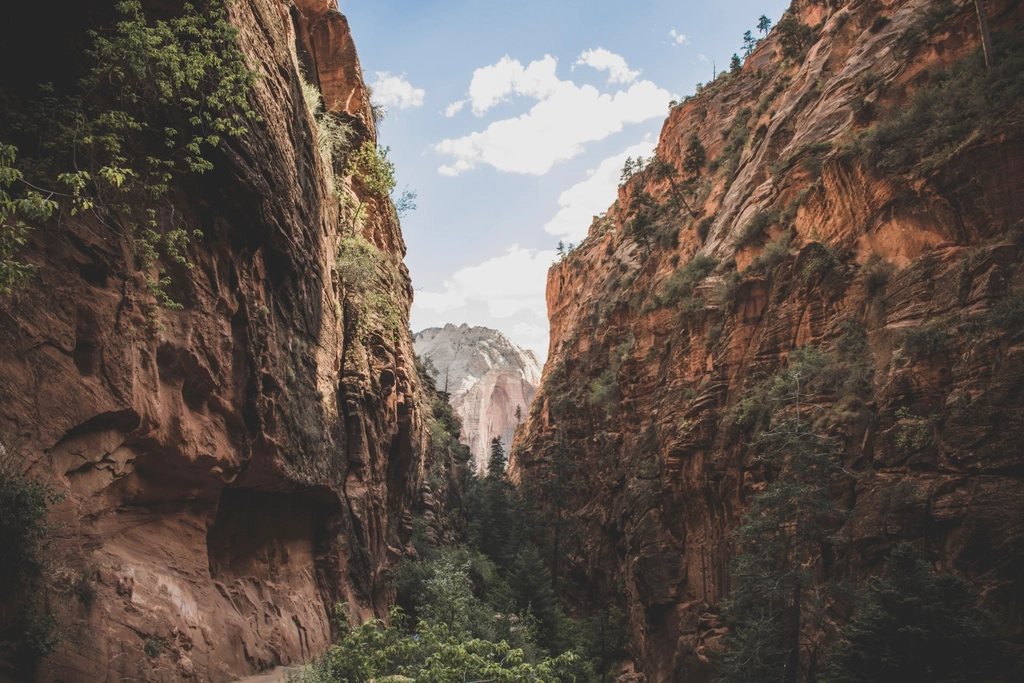
Angels Landing is a fin of red sandstone that rises about 1,500 ft (457 m) above the floor of Zion Canyon in southwest Utah, and the trail to its summit is the most famous, most photographed and most argued-about day hike in the American national parks. The last half mile follows a knife-edge ridge with bolted chains for handholds and drops of hundreds of feet on both sides. It is short, it is spectacular, and it is not for everyone. Here is how it works and what it actually feels like.
The numbers: distance, elevation and time
The round trip from the Grotto trailhead is 5.4 miles (8.7 km) with about 1,500 ft (457 m) of elevation gain. Most people take 3 to 5 hours, and the range is wide because the chain section can be slow when it is busy. The trail starts at 4,300 ft (1,310 m) and tops out at 5,790 ft (1,765 m) on the summit.
The first two miles follow the West Rim Trail, a paved path that is gentle at first, then climbs a series of switchbacks cut into the canyon wall, ducks into the cool slot of Refrigerator Canyon, and then hits Walter’s Wiggles. The Wiggles are 21 tight, steep switchbacks stacked one on top of the other, built in the 1920s and named for the park’s first superintendent who helped engineer them. They are hard on the lungs but never scary. At the top you reach Scout Lookout, a broad sandy saddle with a pit toilet and a view straight down into the canyon. This is where the permit check happens and where the real decision is made.
The chain section, honestly described
From Scout Lookout, the last 0.5 mile (0.8 km) climbs about 500 ft (150 m) along the spine of the fin. There are chains bolted to the rock on the exposed parts, carved steps in places, and sections of bare slickrock where you use your hands. In two or three spots the ridge is only a few feet wide with a sheer drop on each side. The rock is grippy when dry and treacherous when wet or icy.
The physical difficulty is modest; the mental difficulty depends entirely on how you feel about exposure. If heights bother you, Scout Lookout is a fine place to stop, and there is no shame in it; the view from there is already among the best in the park. Two things make the chains far safer: going early before the traffic builds, and following the informal rule that people coming down yield to people going up, with everyone waiting at the wide spots rather than passing on the narrow ones. Fatalities have happened on this ridge, roughly one every couple of years, almost always involving a fall from the unchained edges or rushing in poor conditions.
The permit lottery in general terms
Since 2022, anyone who wants to go beyond Scout Lookout onto the chain section needs a permit. The system is a lottery rather than first come first served. In general terms, there is a seasonal lottery that opens for a set window a few months before each season, where you enter with a range of preferred dates and pay a small application fee; winners then pay a per-person fee. There is also a day-before lottery for a smaller number of permits, which is what we use when our plans are loose. Permits are checked by rangers at Scout Lookout, and the permit holder must be present with a photo ID. Group sizes are capped. The exact fees, windows and quotas shift year to year, so check the park’s current pages before you build a trip around it.
Our experience is that the lottery odds are reasonable outside the busiest spring break and autumn weekends, and much better if you are flexible on dates and willing to take an early or late time slot. Without a permit you can still hike to Scout Lookout, and you can still continue past it onto the West Rim Trail, which is a lovely, quiet high-desert walk that hardly anyone bothers with.
The shuttle and getting to the trailhead
For most of the year, from roughly March through late November and on winter holiday weeks, private cars are not allowed on the Zion Canyon Scenic Drive. You park in the town of Springdale or at the visitor center, take the free park shuttle, and get off at stop 6, The Grotto. The first shuttles leave before sunrise in summer, and being on one of them is the single best thing you can do for this hike. Parking at the visitor center fills by early morning in peak season, so many people park in Springdale and ride the town shuttle to the park entrance. The park entrance fee is charged per vehicle or per person and is separate from the permit.
Heat, ice and the right season
Zion is a desert canyon. In June, July and August the temperature on the exposed switchbacks and the chains regularly exceeds 100 degrees Fahrenheit (38 C) by late morning, and heat illness is the most common reason rangers are called. Start at dawn, be off the chains by 9 am, and carry more water than you think you need. Summer afternoons also bring thunderstorms, and lightning on an exposed fin is a real risk. In winter the chains can be coated in ice and the sandstone steps become skating rinks; rangers close the section in those conditions, and microspikes are a sensible carry from December to February.
Our favourite months are April, May, October and early November: warm days, cool mornings, and cottonwoods turning gold in the canyon in autumn. Whatever the season, here is the short list we go through the night before:
- Permit confirmed, printed or saved offline, with ID for the permit holder.
- Shoes with sticky rubber soles, not trail runners with worn tread.
- 2 litres of water per person, salty snacks and a small first-aid kit.
- Gloves are optional but many people like them on the chains.
- Leave the trekking poles strapped to the pack on the chains; hands need to be free.
Worth the nerves?
Standing on the summit of Angels Landing, with the Virgin River curling far below and the canyon walls glowing in early light, is one of the great moments in American hiking. The permit system has thinned the crowds and taken away the worst of the gridlock on the chains, which has made the experience calmer and, we think, safer. If you win a slot, take the earliest one you are offered, walk steadily, and know that turning around is always an option.