
The first time we heard a bear in camp, it was a black bear, unhurried and curious, working its way down a line of tents toward a bag of trail mix someone had left in a vestibule. Nobody was hurt. The bear got the trail mix, it came back the next night, and by the end of the summer the rangers had to shoot it. That is how it usually goes. Bad food storage does not endanger campers nearly as much as it endangers bears, and the whole point of doing it properly is that a bear which never gets a reward from a campsite has no reason to return.
Black bear country and grizzly country
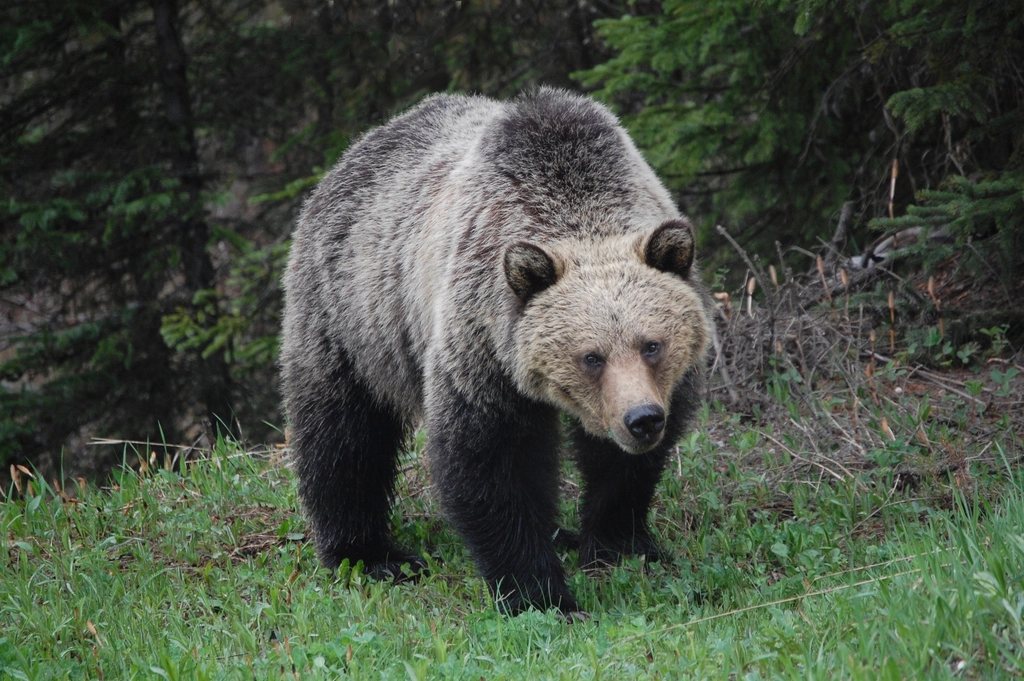
The habits below apply everywhere bears live, but it helps to know which kind you are sharing the woods with. Black bears live across most of the forested United States and Canada, from the Appalachians to the Sierra Nevada, and are the bear you are most likely to meet. They are excellent climbers, good at problem solving, and mostly interested in your food rather than in you. Grizzly bears, or brown bears, live in the northern Rockies, in parts of Montana, Wyoming, Idaho and Washington, across western Canada and throughout Alaska. They are larger, less inclined to climb, and more defensive of their space and their cubs. In grizzly country, storage rules tend to be stricter, the distances longer, and bear spray goes from a good idea to standard equipment.
The behaviour that matters most is the same for both. A bear that has learned to associate people with food loses its fear of people and becomes dangerous. The most useful thing we can do as campers is make sure that never happens.
Canisters and where they are required
A bear canister is a hard-sided container, usually a cylinder about 20 cm across and 30 cm tall, holding around 11 litres, which a bear cannot open and cannot carry off. They weigh between 900 grams and 1.3 kg empty, and they will hold roughly five to seven days of food for one person if you repackage everything and pack it tightly. Many national parks in bear country require them in the backcountry, particularly in the Sierra Nevada, the Adirondacks and parts of the Rockies, and rangers there check at trailheads and in camp. Some parks issue loaners or rent them for a small fee. Where they are required, hanging food is not an accepted substitute.
Using one is simple. Everything with a smell goes in it: food, wrappers, trash, toothpaste, sunscreen, lip balm, the pot you cooked in if you cannot clean it fully. At night it sits on the ground, at least 30 metres from the tent, wedged among rocks or logs so a bear cannot roll it off a ledge or into a stream. Do not tie anything to it; a cord gives the bear a handle. Keep it closed whenever you are not reaching into it.
The PCT hang
Where canisters are not required and there are suitable trees, a proper hang works well, and the PCT method is the one we teach because a bear cannot defeat it by pulling on the rope. You need about 15 metres of 3 mm cord, a small carabiner, a stuff sack, and a short stick. Find a branch at least 5 metres up and strong enough to hold the bag 2 metres out from the trunk. Throw the cord over the branch with a small rock bag as a weight. Clip the carabiner to the food bag, pass the standing end of the cord through the carabiner, and haul the bag all the way up to the branch. Reach as high as you can on the rope and tie a clove hitch around the stick. Let the bag drop until the stick jams against the carabiner.
The bag now hangs about 4 metres off the ground, 2 metres from the trunk, and 1 to 2 metres below the branch. There is no rope tied off at the tree, so a bear cannot chew or pull anything to lower it. To retrieve, pull the rope down, remove the stick, and lower away. The whole operation takes ten minutes in daylight and thirty in the dark, which is why we hang before dark.
The triangle and the 100-metre rule
The classic camp layout in bear country is a triangle. The tent is one corner. The cooking and eating area is a second corner. The food storage, whether canister or hang, is the third. The sides of the triangle are at least 100 metres each where the terrain allows, and downwind of the tent for cooking and storage. The idea is that any bear drawn in by smell arrives at the kitchen or the food, not at the sleeping people, and that the smells of cooking do not settle into the tent fabric.
In practice, 100 metres is often impossible in a small designated site, and 50 metres is a reasonable compromise. What is never a compromise is the tent itself. Nothing scented goes into the tent, ever: no snacks, no toothpaste, no deodorant, and not the clothes you cooked in. A dedicated shirt for cooking, swapped out and stored with the food, is a small effort that removes the most common mistake.
Scented items and camp habits
People remember the food and forget everything else with a smell. The list of things that belong with the food is longer than most people expect:
- All food, drinks other than plain water, and every wrapper and crumb
- Toiletries: toothpaste, sunscreen, insect repellent, lip balm, soap, wet wipes
- Trash, used tea bags, coffee grounds, and the water you rinsed the pot with
- Medications, lozenges, gum, and anything with a fruit or mint flavour
- Pet food, feminine hygiene products, and used dishcloths
Cook and eat at the kitchen corner, not at the tent. Strain dishwater through a bandana, pack out the solids, and scatter the water widely at least 60 metres from any stream. Eat everything you cook; leftovers are heavy to carry and irresistible to a bear. Pack the kitchen away completely before dark rather than leaving it for the morning. If a bear does come into camp, make noise, stand together, and let it leave. Do not chase it, and do not let it have anything.
Beyond bears
The same habits protect against the animals you are far more likely to meet. Mice chew through pack fabric for a single crumb, marmots and ravens open zippers, and raccoons can work a buckle. A canister or a proper hang defeats all of them. The rules are not about fear. They are about leaving a camp as wild as we found it, and coming back next year to find the bears still wary, still wild, and still there.