
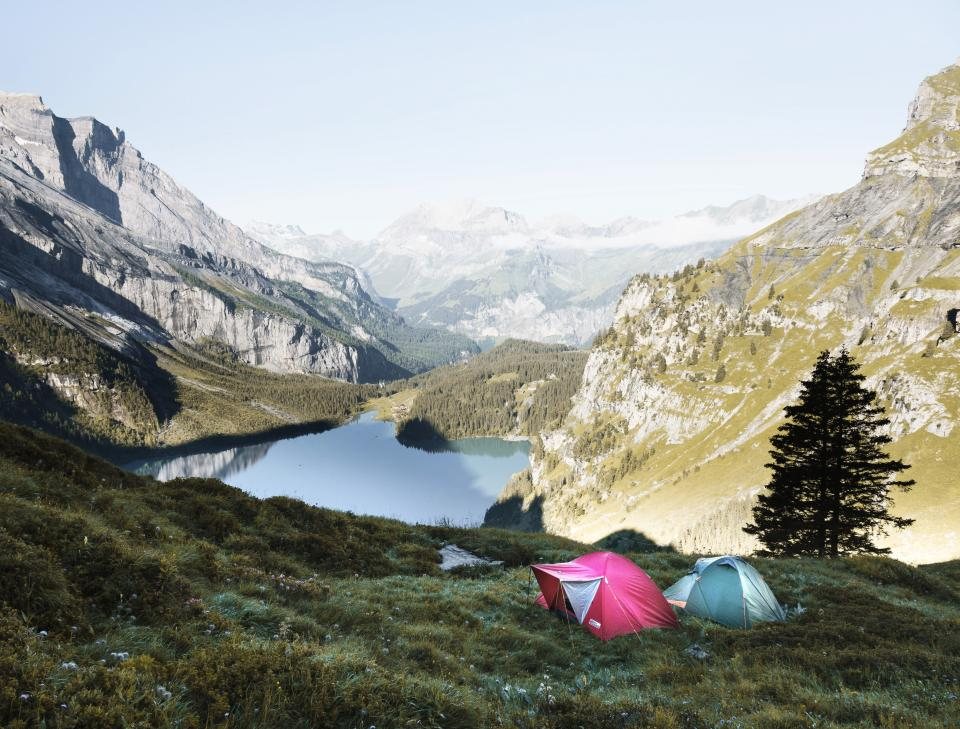
Where you put the tent decides how the night goes. We have slept in a hollow that filled with cold air and frost while the ridge 20 metres above stayed mild, under a dead pine that we only noticed at breakfast, and on a beautiful patch of meadow that turned out to be the only route the stream had when the rain came. Each of those nights could have been avoided in the ten minutes we spent choosing the spot. Picking a campsite is a small skill that pays every night, and it has two halves: leaving the place undamaged, and sleeping well.
Durable surfaces first
The starting point is the ground itself. A tent, a stove and four people moving around for twelve hours compact soil, crush plants and kill the fragile crust that holds a meadow or a desert floor together. Some surfaces shrug that off and some take years to recover. Established campsites with bare, hardened ground are the best choice by far, and using them concentrates the impact on a place already damaged instead of spreading it. Where there is no established site, look for rock, gravel, sand, dry grass, snow, or duff under trees, all of which recover within a season. Avoid wet meadows, alpine tundra, cryptobiotic soil in the desert, and any surface where the tent will leave a visible mark in the morning.
In popular areas the rule is to use the existing site and not enlarge it. In pristine areas the rule flips: spread out, camp for one night only, and move on, so that no single spot gets used enough to become a site.
The 60-metre rule and water
Camp at least 60 metres from any lake, stream or spring, which is about 70 adult paces. The distance protects the water from soap, food scraps and human waste, keeps the shoreline vegetation intact, and leaves the water free for the wildlife that comes to drink at dawn and dusk. In many parks and forests the distance is a regulation rather than a guideline, and some set it at 30 metres or 100 metres, so check the local rules. The same 60 metres applies to the trail and to other people’s camps: nobody wants to wake up with a stranger’s tent 10 metres away or to walk through someone’s kitchen on the way past.
A practical bonus of the distance is that it takes you out of the cold, damp air along watercourses, and out of the flood zone of a stream that rises in a storm. A dry gully, a sandbar, a flat bench just above a creek: these become wet very suddenly.
Cold air, wind and the shape of the land
Cold air is heavier than warm air, and at night it drains downhill like water, pooling in valley bottoms, hollows and the floors of bowls. The difference between a hollow and a rise 10 metres higher can be 5 C or more on a clear, still night, and it decides whether you wake to frost on the tent. The warmest spots are gentle slopes or small shelves partway up a valley side, where the cold air keeps moving past instead of collecting. Under trees is warmer than open ground, because the canopy traps the heat radiating from the earth; on a clear night, open ground can be 3 or 4 C colder than a spot 20 metres inside the forest edge.
Wind pulls the other way. Ridge crests and passes take the full force of whatever is blowing, and a 50 km/h gust at 2 a.m. will flatten a tent that was fine at dusk. The ideal is a site sheltered by a rise, a boulder or a band of trees on the windward side, with the tent’s narrow end pointing into the wind. If a storm is forecast, come down off the ridge and give up the view. The tallest object in an open area, or the base of a lone tree, is not where to be in a thunderstorm.
Widowmakers and what is overhead
Look up before you unpack. A widowmaker is a dead tree, a dead limb, or a hung-up snag leaning in another tree’s branches, and every year they kill campers who chose a pretty spot in the forest without looking above it. Check every tree within falling distance of the tent, which means a radius equal to the height of the tallest tree nearby, typically 20 to 30 metres. Dead bark, no needles or leaves, fungus on the trunk, a visible lean, or a crack at the base are all reasons to move. Standing dead trees in a burn area are the worst case, and the safe choice is often to camp well outside the burn entirely. In wind, the risk multiplies: branches that would hold for years come down in the first strong gust.
Drainage and a flat bed
Water runs downhill, and it will run through your tent if the tent is where it wants to go. Look at the slope and imagine a heavy rain: where would the water flow, and where would it pool? A slight convex rise, where the ground falls away gently on all sides, sheds water and is the best bed there is. A dip, a saddle, or the base of a slope collects it. Never dig a trench around the tent; choose a spot that does not need one. Check the ground for rocks and roots by lying down before you pitch, and if there is a slight slope, put your head uphill. A slope of more than a few degrees is worth walking further to avoid.
The seven principles, in practice
Everything above sits inside the broader idea of Leave No Trace, which is usually summarised as seven principles. In the context of choosing and using a campsite they look like this:
- Plan ahead: know the local rules on distances, fires and group size before you leave
- Travel and camp on durable surfaces: established sites first, then rock, gravel, snow or dry grass
- Dispose of waste properly: catholes 15 to 20 cm deep and 60 metres from water, pack out paper and everything else
- Leave what you find: no trenches, no new fire rings, no cut branches, no moved rocks
- Minimise campfire impact: use existing rings, keep fires small, or skip them and use a stove
- Respect wildlife: store food properly and keep the 60-metre buffer from water they drink from
- Be considerate of others: camp out of sight and sound of the trail and other groups where you can
Before leaving in the morning, walk the site once more. Fluff flattened grass, scatter any gathered stones or pine needles, and check for micro-trash: a twist tie, a corner of a wrapper, a tent peg. If the next person cannot tell anyone slept there, you chose well, and you probably slept well too.