
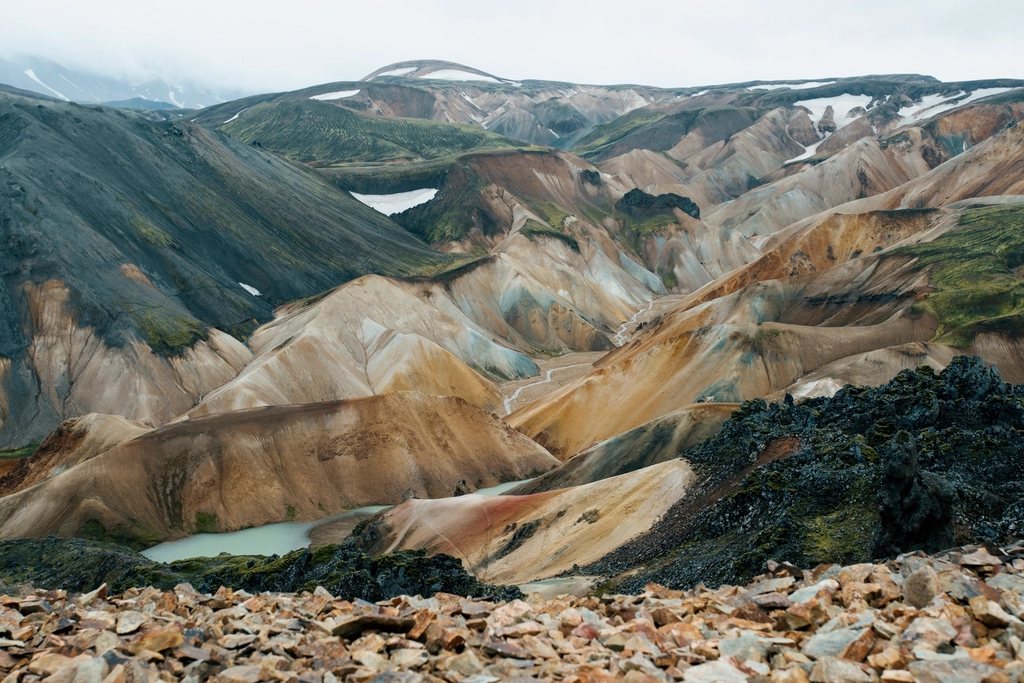
The Laugavegur is Iceland’s most famous trek and, for once, the reputation is earned. In 55 kilometres it runs from the steaming rhyolite hills of Landmannalaugar to the birch woods of Thorsmork, passing through a landscape that changes character every few hours: obsidian lava fields, snowfields in June, black sand deserts, green mossy canyons and glacial rivers that must be waded. We have walked it three times and it has never looked the same twice. This guide covers the stages, the huts, the fords and the extension to Skogar.
The route in four days
The classic itinerary takes four days and three nights, walked from north to south so that the big climb comes first. Day one climbs from Landmannalaugar at about 600 metres through the multicoloured hills and steaming vents to the hut at Hrafntinnusker at about 1,100 metres, a distance of 12 kilometres and the highest and coldest night of the trek. Day two descends 12 kilometres over snow patches and a steep scree slope to the lake at Alftavatn, with the first wide view of the glaciers to the south. Day three is the longest at 15 kilometres, crossing the black sand plain of Maelifellssandur to the huts at Emstrur, with the deep canyon of the Markarfljot river just beyond. Day four covers 16 kilometres of descent past the canyon and through the first birch scrub to Thorsmork, a green valley of woods and campsites hemmed in by glaciers.
The total ascent is only about 1,000 metres and the descent about 1,400, so the difficulty is not the climbing. It is the weather, the exposure and the rivers.
Huts and camping
There are mountain huts at each stage: Hrafntinnusker, Alftavatn or the smaller Hvanngil a little further on, Emstrur, and several in Thorsmork. They are warm, simple and staffed by wardens in summer, with bunks, gas cookers and running water. Beds are limited and sell out months ahead for July and August, so booking early is the single most important piece of planning. The alternative is to camp beside the huts, which is cheaper and does not require a reservation, though it means carrying a tent that will stand up to wind. Wild camping away from the huts is not allowed inside the protected area, and the wardens enforce it.
Camping at Hrafntinnusker is a cold experience even in July, with snow often still on the ground around the tent pitches. Alftavatn and Emstrur are gentler, and Thorsmork is positively lush. Small shops at some huts sell snacks and gas, but there is no real resupply, so we carry all the food for four days and buy a treat if one turns up.
The rivers
Several rivers on the Laugavegur are bridged, but a few must be forded, and this is where the trek asks something of you. The main ones are the Bratthalskvisl before Alftavatn, the Blafjallakvisl beyond Hvanngil, and the Thronga shortly before Thorsmork, which is the widest and, in warm afternoons, the deepest. Glacial rivers rise through the day as the ice melts, so morning crossings are easier. We use sandals or old shoes, unbuckle the pack, face upstream with poles, and cross where the water is wide and shallow rather than narrow and fast. Water above the knee in a strong current is a signal to look elsewhere or wait. The cold is the surprise; a two-minute ford leaves feet numb for ten.
Weather and snow
The trail is usually open from late June to early September, when the huts are staffed and the highland roads have been cleared. In June the section around Hrafntinnusker can be entirely snow-covered, with the route marked by stakes, and fog is common. Even in August a summer storm can bring horizontal rain and wind strong enough to flatten tents, and the temperature at the high hut can drop to freezing at night. There are no trees, no shelter and no mobile signal for much of the route. We carry full waterproofs, warm layers, gloves and a hat, and check the forecast with the wardens each morning. The huts are also where a walker can wait out a bad day, and the wardens will tell you when not to leave.
Water is never a problem. Clear streams and springs are frequent, and in Iceland the running water is generally safe to drink without treatment. We avoid the milky glacial rivers, which are full of silt, and fill bottles from the small side streams.
Getting there and the Skogar extension
Both ends are served by highland buses in summer, with four-wheel-drive coaches running from the capital to Landmannalaugar and out from Thorsmork. The roads to both are unpaved and cross rivers, so private cars need to be proper off-road vehicles. Many walkers spend a night at Landmannalaugar before starting, to soak in the natural hot spring and walk the short loops through the lava and the coloured hills.
The classic addition is the Fimmvorduhals pass, which continues from Thorsmork over the col between two ice caps to Skogar on the south coast. It is about 25 kilometres with roughly 1,000 metres of climbing, usually done in one long day or two with a night in the hut near the top. The route crosses the fresh lava and craters of the 2010 eruption, still warm in places, and finishes past a chain of waterfalls to the great fall of Skogafoss. It is the finest single day of walking in Iceland when the weather is clear and a frightening place in fog, so we give it a spare day and take it only with a good forecast.
Our planning notes
Book the huts as soon as the dates are fixed, or commit to camping and carry a strong tent. Walk north to south. Cross rivers in the morning. Pack for winter conditions in midsummer. And add the Fimmvorduhals if there is any chance of a clear day.
- Distance: 55 km Landmannalaugar to Thorsmork, plus about 25 km to Skogar over Fimmvorduhals
- Days: 4 for the main trail, 5 or 6 with the extension
- Huts: Hrafntinnusker, Alftavatn or Hvanngil, Emstrur, Thorsmork; camping beside them without reservation
- Season: late June to early September, with snow near Hrafntinnusker into July
- Rivers: three main fords, easiest in the morning
The Laugavegur is short enough for a long weekend and dramatic enough for a lifetime of stories. Go prepared for the weather and it will give you the best four days of colour you have ever walked through.