
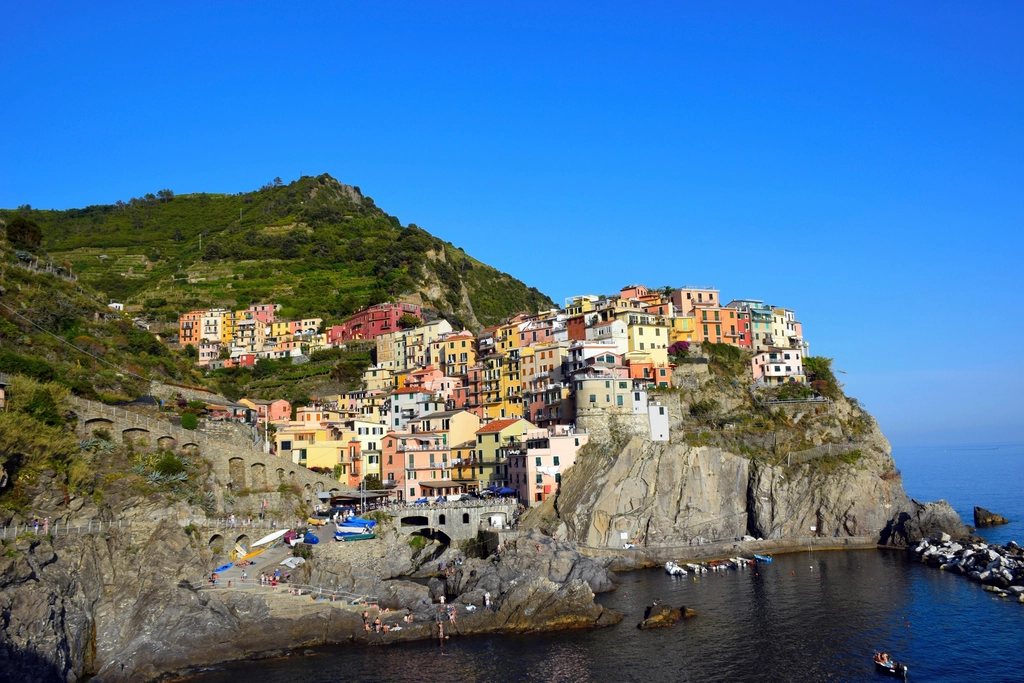
The five villages of the Cinque Terre cling to the Ligurian coast between La Spezia and Levanto, stacked in pastel tiers above tiny harbours and terraced vineyards. A coastal footpath, the Sentiero Azzurro or Blue Trail, links them, and walking it village to village is one of the best short-distance hikes in Europe. It is also more complicated than it looks: sections close for years after landslides, the open parts charge a fee, the steps are merciless in August, and the trains are both a lifeline and a crowd delivery system. We have walked what we could of it in April, June and October, and we have come to love it in its unpredictable way.
The path and its five villages
From north to south the villages are Monterosso al Mare, Vernazza, Corniglia, Manarola and Riomaggiore. The full Sentiero Azzurro is about 12 km (7.5 miles), but the two southern sections have been closed for most of the last decade. The Via dell’Amore between Riomaggiore and Manarola, a short paved cliff walk, was hit by a rockfall in 2012 and spent years under reconstruction before reopening in stages with timed access. The Manarola to Corniglia section has been closed since a landslide and remains so; a higher inland alternative via the village of Volastra exists, but it is a much stiffer walk.
What is reliably open, and what most people mean when they talk about hiking the Cinque Terre, are the two northern sections: Monterosso to Vernazza and Vernazza to Corniglia. Together they make a satisfying half day.
Monterosso to Vernazza: the hard one
This section is about 3.5 km (2.2 miles) and takes 1.5 to 2 hours. Do not let the distance fool you. Leaving Monterosso you climb immediately on stone steps that go on for about 20 minutes, gaining around 170 m (560 ft) with the sea falling away behind you. The path then rolls along the hillside through lemon groves, olive terraces and stretches of Mediterranean scrub, with several more short, steep climbs on uneven stone. The final descent into Vernazza is the classic view: the village and its little harbour framed by vines, appearing suddenly below you. It is narrow in places with a drop on one side, and passing walkers coming the other way requires patience and good manners.
Vernazza to Corniglia: the pretty one
The second section is around 3.2 km (2 miles) and also takes about 1.5 hours. It climbs out of Vernazza past the cemetery, again on steps, then contours along the hillside with long views back over Vernazza and ahead to Corniglia perched on its promontory about 100 m (330 ft) above the sea. It is a little less steep than the first section but has more rough footing and a few muddy patches after rain. Corniglia is the only village without direct sea access, and reaching its railway station from the village means the Lardarina, a stair of 377 steps. Walking down them at the end of a warm morning is fine; walking up them is a rite of passage.
Trail cards, fees and closures
The Sentiero Azzurro sits inside the Cinque Terre National Park, and the open coastal sections are fee-charging. In general terms, you buy a trail card, either a walking-only version or a combined version that includes unlimited regional train travel between Levanto and La Spezia for the day. The cards are sold at park information points in the villages, at railway stations and online, and there are checkpoints at the start of each paid section. Children, and everyone on some off-season dates, are often exempt or discounted, but the details change, so check the current park information before you travel rather than trusting a blog post from three summers ago.
Closures are the other thing to check. The park posts the status of every section, and after heavy rain a section can shut with almost no notice. We have arrived at Vernazza with boots on to find the path to Corniglia closed by a fresh slip. Having a train timetable in your pocket turns that from a disaster into a shrug.
Trains, heat and how to plan a day
The regional railway runs along the coast with stations in every village, most of them in tunnels with a brief glimpse of sea. Trains between neighbouring villages take three to five minutes, and in summer they run every 15 to 30 minutes. In practice the train lets you walk the sections you want and skip the rest. Our favourite plan is to take an early train to Monterosso, walk to Vernazza for a late breakfast, continue to Corniglia for lunch, then ride the train to Manarola and Riomaggiore in the afternoon. It gives you the full necklace of villages without the closed sections.
Heat is the enemy in July and August. The paths are exposed, the stone reflects the sun, and by midday the steps out of Monterosso can feel like a furnace. Start walking by 8 am, carry at least 1.5 litres of water each (the villages have fountains, the trail has none), and wear a hat. The shoulder seasons are much kinder. April and May bring wildflowers and mild days, though rain is more likely; late September and October are warm, quieter and have the added bonus of the grape harvest on the terraces. In deep winter parts of the trail may close for maintenance and the train service thins out.
A few practical notes we always pass on:
- Wear proper walking shoes with grip; the park rangers can turn back people in flip-flops or smooth-soled sandals, and the steps are slippery when wet.
- Walk north to south in the morning so the sun is mostly behind you on the climbs.
- Book accommodation in the villages or in Levanto and La Spezia well ahead; rooms are scarce in high season.
- Expect crowds on the paths between 10 am and 4 pm from May to September; the trail is one way in the narrowest spots, and queues form.
- Keep an eye on the park closure list the morning you walk.
The villages beyond the path
The hiking is the reason to come, but the villages are the reason to linger. Vernazza has the best harbour and the busiest square. Manarola gives the famous evening view from the path above the harbour, where the houses glow in low light. Riomaggiore is the largest and has the best focaccia we have found on the coast. Corniglia, up on its rock, is the calmest, and Monterosso has the only real beach. Give yourself two days if you can, walk in the mornings, swim or sit in the afternoons, and let the trains do the connecting. It is a small place with a lot in it.
Read next: The Wave Lottery: Daily vs. Advance Permits for Coyote Buttes North