
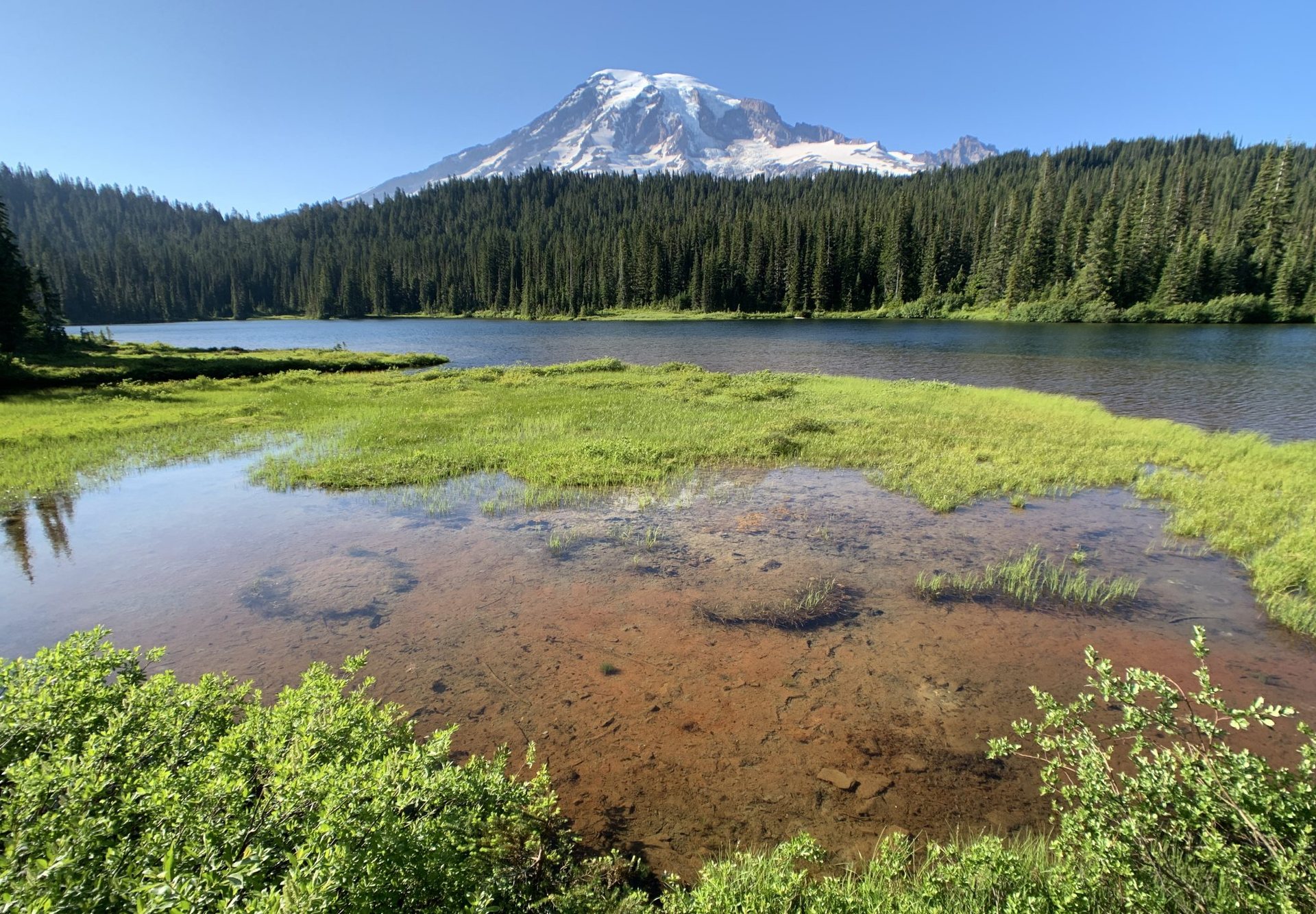
The Wonderland Trail does exactly what its name suggests. It circles Mount Rainier, the 14,410 foot volcano that dominates the skyline of the Pacific Northwest, and for 93 miles the mountain is always there, sometimes filling the whole horizon and sometimes hidden behind a ridge you are about to climb. We have walked it once in ten days and once in eight, and both times the permit was harder to get than the trail. This guide explains how the circuit works, how the permit system operates, and what the glaciers do to your plans.
A loop with no flat days
The trail is about 93 miles, or 150 kilometres, and gains roughly 22,000 feet, about 6,700 metres, over the full loop. That is the number to respect. The route does not stay on a ridge; it drops into every glacial valley that radiates from the mountain and climbs out the other side, so a typical day involves 2,500 to 3,500 feet of ascent and the same descent. The high point is Panhandle Gap at about 6,800 feet on the east side, between Summerland and Indian Bar, and the low points are the river crossings near Longmire and the Carbon River at around 2,300 feet.
Most people take nine to twelve days. Eight is possible for strong walkers who do not mind long days. The usual starting points are Longmire in the south-west, White River or Sunrise in the north-east, and Mowich Lake in the north-west, all reachable by car. Direction is a matter of taste; clockwise from Longmire gets the steep, forested western side done early, while counter-clockwise saves the alpine meadows of Summerland and Indian Bar for the finish.
The permit and the lottery
A wilderness permit is required for every night on the trail, and each night must be assigned to a specific camp. Demand is far higher than supply, so the park runs an early access lottery each spring. Applicants submit a request during a window in early spring, results are drawn, and winners are given a slot in which to build an itinerary from whatever camps remain. Permits not taken in the lottery are released later in a general on-sale, and a share of each camp is held back for walk-up requests at the ranger stations the day before or the day of a start.
Two habits make the lottery less painful. First, be flexible on dates, direction and start point: a request that can begin at any trailhead on any day in a two-week window has a far better chance than one fixed to a Saturday at Longmire. Second, plan a realistic itinerary in advance with several alternatives, because when your slot arrives the camps you wanted may already be gone and you will have minutes, not hours, to adapt.
Camps, caches and bears
There are eighteen backcountry camps on the loop plus a handful at the road-accessible points. Each has a few numbered sites, a pit toilet, a nearby water source and a bear pole for hanging food. Familiar names include Mystic Lake below the Carbon Glacier, Summerland and Indian Bar in the alpine east, Klapatche Park and Golden Lakes on the west side, and Devils Dream near Longmire. Campfires are not permitted anywhere on the trail, so a stove is essential. Black bears live around the mountain; hang everything with a smell on the pole and cook away from the tent.
Food caches are the reason the trail is manageable. The park allows walkers to leave food in hard-sided containers, or to mail them ahead, at Longmire, Mowich Lake and White River. A loop from Longmire with caches at Mowich and White River means never carrying more than four days of food. We label the containers clearly, include a spare fuel canister and a treat, and check the current rules for delivery dates and container types before we ship anything.
Snow, rivers and the short season
Rainier makes its own weather and holds its snow. In a normal year the high sections, especially Panhandle Gap, the Spray Park variant and the meadows above Mystic Lake, are under snow until mid-July, and the Wonderland is really a late July to late September trail. Early season walkers need route-finding skills on snow slopes, and the park closes some sections when the risk is high. Late September brings frost, short days and the first storms, but also the huckleberries and the fall colours in the meadows.
The rivers deserve their own paragraph. Every major drainage carries glacial meltwater, grey with silt and rising through the day as the sun works on the ice. The park builds seasonal log bridges across the big ones such as the Carbon, the Nisqually, the South Puyallup and the White, and washouts are routine. When a bridge is gone, the crossing is a serious ford. We cross in the morning when flows are lowest, unbuckle hip belts, face upstream with poles, and never step into water we cannot see the bottom of. If it looks wrong, we wait for the level to fall or walk out.
Water, weather and kit
Water is never far away, though we filter every drop and avoid the silty glacial streams when a clear side creek is nearby, since silt clogs filters quickly. Rain is a real possibility even in August, and the west side stays damp long after the rest of the mountain dries. Our kit is standard three-season gear plus a proper rain shell, a warm layer for camps at 5,000 feet, gaiters for the snow patches, and poles for the endless descents. A map and compass matter more here than on many trails because fog can erase the meadows in minutes. Mosquitoes are fierce in July around the lakes and largely gone by September.
Why we keep going back
The Wonderland is hard on the legs and hard on the calendar, but it rewards both. Every day includes a glacier, a meadow, a waterfall and a long look at the mountain. The camps are small and quiet, and the cache system keeps packs honest. Getting the permit takes patience, so we treat the lottery as the first stage of the trek rather than an obstacle to it.
- Distance: 93 miles / 150 km around Mount Rainier
- Elevation gain: about 22,000 ft / 6,700 m
- Days: 8 to 12, with 18 wilderness camps to choose from
- Permit: required, allocated by a spring lottery plus general sale and walk-ups
- Season: late July to late September; snow on the high sections until mid-July
If you get a permit, take it, whatever dates it offers. The mountain will still be there, but a clear morning at Indian Bar with the summit glowing above the glacier is something we would rearrange a whole summer for.