
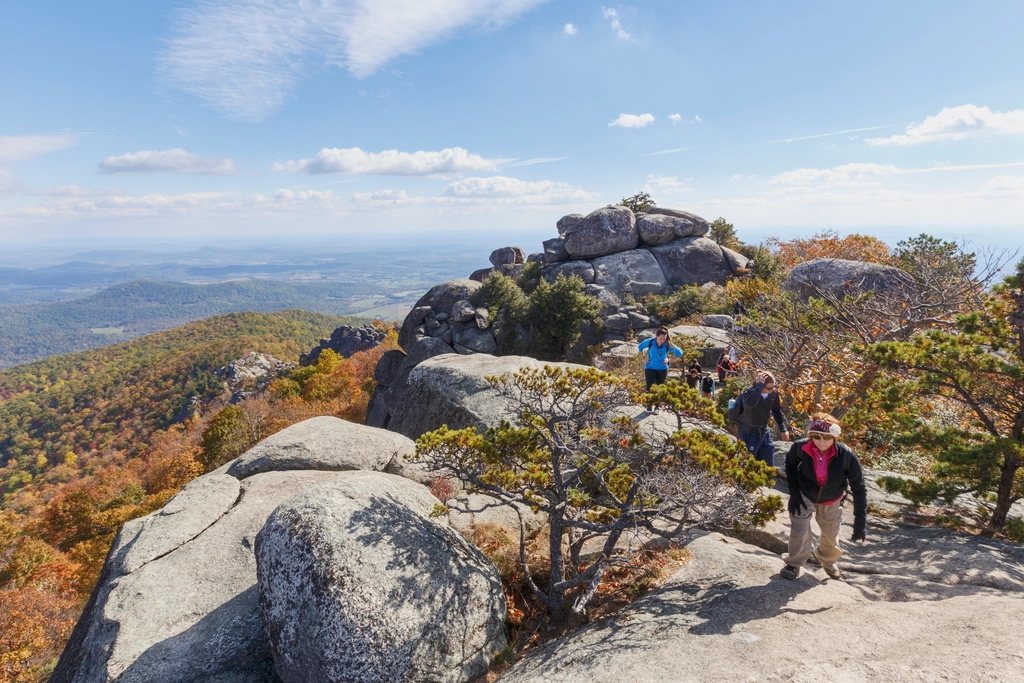
Old Rag Mountain is the hike people in the mid-Atlantic tell you about first. It sits on the eastern edge of Shenandoah National Park in Virginia, a granite dome with a bare, bouldered summit ridge, and the route up it includes a mile-long rock scramble that is unlike anything else in the park. At 3,284 ft (1,001 m) it is not a big mountain. It is, however, a full and demanding day, and on a fine October Saturday it can feel like the busiest place in the Blue Ridge. Here is how we approach it.
The circuit: distance, elevation and time
The classic loop is about 9.4 miles (15.1 km) with roughly 2,400 ft (730 m) of elevation gain, and most groups take 5 to 8 hours. It is walked counterclockwise: up the Ridge Trail, across the summit, and down the Saddle Trail and the Weakley Hollow Fire Road back to the parking area. Going this direction means you climb the scramble rather than descend it, which is both safer and more fun.
From the parking lot at the end of the road near the village of Nethers, the first 0.8 miles is on the road itself, then the Ridge Trail begins climbing through hardwood forest in a long series of switchbacks. The grade is steady rather than savage, but it is relentless for about 2 miles before the trees begin to thin and the first boulders appear. Then the fun starts.
The rock scramble
For roughly one mile along the ridge, the trail becomes a route through, over, under and between enormous granite boulders. Blue blazes painted on the rock mark the way, and you need to look for them, because the obvious line is often not the correct one. There are short chimneys to wedge up, a slot narrow enough that big packs have to be passed through separately, a crack you shuffle along with your back on one wall, and several places where you need to trust your boots on sloping rock and reach for a handhold. Nothing requires ropes, and nothing is dangerously exposed, but it is real scrambling, and children under about eight, dogs and people with bad knees or a fear of tight spaces will struggle.
Two things make the scramble much harder than it needs to be: wet rock and ice. After rain the granite is slick, and in winter the shaded slots hold ice for weeks. On those days we take our time, keep three points of contact, and are not too proud to sit down and slide. The scramble ends at a false summit; the true summit, marked by a survey disk and a jumble of boulders you can climb for a 360-degree view over the Piedmont and the Blue Ridge, is a short walk further on.
The way down
From the summit the Saddle Trail drops steeply for about 1.5 miles through the forest to Old Rag Shelter, a three-sided day-use shelter at a trail junction, then continues to Byrds Nest 3 shelter and on to the Weakley Hollow Fire Road. The fire road is a gentle 2.6 mile stroll along a creek, with the lower parking area at the end of it. The whole descent is straightforward and well marked, which makes it a sensible bail-out if the weather turns before the scramble.
Tickets, parking and getting there
Old Rag has become so popular that the park introduced a day-use ticket system in 2022, in addition to the normal park entrance fee. In general terms, a limited number of tickets are released for each day, most of them a month or so in advance and a smaller batch a few days before, and you buy one online for a small fee before you go. Rangers check for tickets near the trailhead during the ticket season, which runs from roughly March through November. The system has made a real difference to summit crowding, but it also means a spontaneous Saturday trip in October is unlikely to work; plan ahead.
The trailhead is reached by narrow country roads from the town of Sperryville, about 90 minutes from Washington, DC, and is not on any public transport route. The main parking lot holds a couple of hundred cars and fills by 8 am on fine weekends, after which the road is closed to further traffic. There is a fee station and toilets at the lot. There is no water at the trailhead or on the trail; carry everything, and in summer that means at least 2 to 3 litres per person.
Seasons, crowds and hazards
Spring and fall are the seasons that make Old Rag famous. In April and May the mountain laurel and rhododendron bloom along the lower trail, and the views are clear. In October the leaves turn, the air is dry, and the summit boulders are the best seat in Virginia for the colour. Those are also the busy months. On peak weekends there can be a slow-moving queue at the tightest sections of the scramble, and the summit can be a picnic ground. Arriving before 7 am, or coming on a weekday, changes the experience completely.
Summer is hot, humid and stormy. Afternoon thunderstorms are common from June through August, and being on bare granite in lightning is genuinely dangerous; start early and be off the ridge by early afternoon. Winter is quiet and beautiful, but ice in the scramble can turn a fun day into a serious one, and the road can be treacherous after snow. Timber rattlesnakes and copperheads live in the rocks and are occasionally seen sunning on the boulders in warm months; look before you place a hand, and give them room.
The short list we run through before an Old Rag day:
- Day-use ticket and park entrance fee sorted, saved offline; cell coverage at the trailhead is poor.
- Shoes with sticky soles; the scramble punishes worn tread.
- A small pack that fits through the slots, with water, food and a layer for the windy summit.
- An early start, both for parking and for empty rock.
- A weather check for storms and, in winter, for ice on the ridge.
Why we keep coming back
Old Rag is not the tallest peak in Shenandoah, and the drive is a bit of a nuisance, but the combination of forest, granite and that long hands-on ridge is hard to match anywhere east of the Rockies. It is a hike that makes people laugh out loud in the slots and go quiet on the summit. Get your ticket, get up early, and take the loop counterclockwise. You will understand the fuss by the second boulder.