
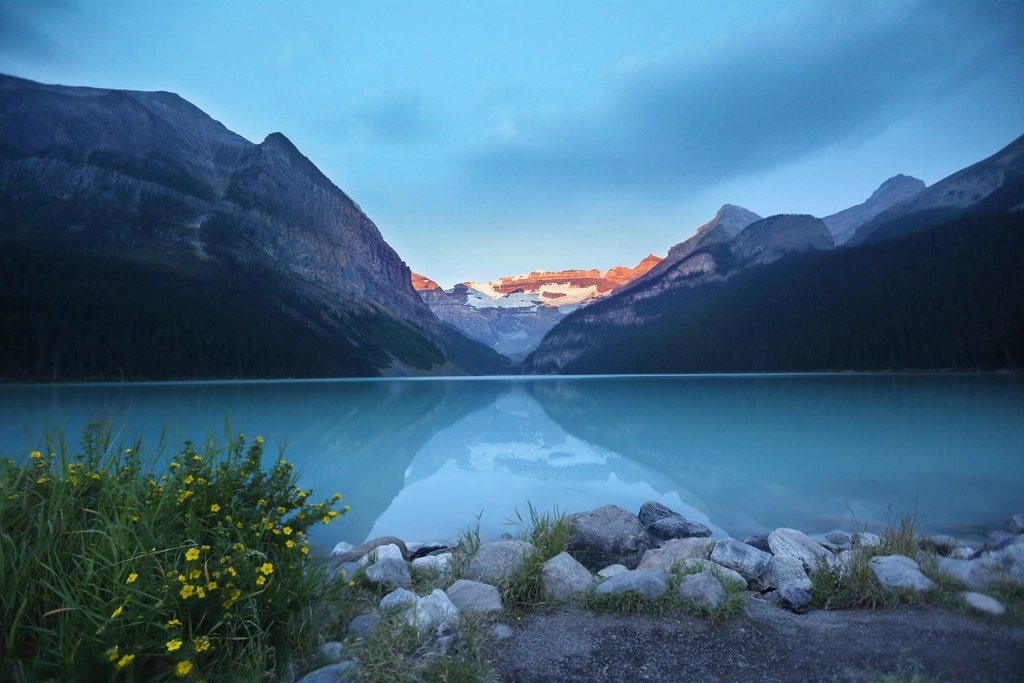
Lake Louise is the most photographed lake in the Canadian Rockies, and on a summer morning the shoreline in front of the big hotel can feel like a train station. Walk a few hundred metres along the lakeshore path, though, and the crowd thins with every step. Two trails climb out of the valley from there, one to the Plain of Six Glaciers and one to Lake Agnes, and linking them over the Big Beehive makes a loop of about 14 to 15 km (8.7 to 9.3 miles) that we think is the finest single day walk in Banff National Park. Here is how we do it.
The loop and its numbers
The full loop from the Lake Louise lakeshore is around 14.6 km (9.1 miles) with about 800 m (2,600 ft) of cumulative elevation gain, and it takes most people 6 to 8 hours with stops. The lake sits at 1,731 m (5,680 ft). The Plain of Six Glaciers teahouse is at about 2,100 m (6,900 ft), the top of the Big Beehive at about 2,270 m (7,450 ft), and Lake Agnes at 2,135 m (7,005 ft). Nothing on the loop is technical, but the climb up the back of the Big Beehive is steep and rocky, and the trail from the Six Glaciers side is narrow with drop-offs in places.
We prefer the loop clockwise: lakeshore first, then up to the Plain of Six Glaciers, then the Highline Trail and the Big Beehive, and down past Lake Agnes and the Beehive switchbacks to the lake. Going this way puts the biggest climb early in the day and saves the descent past Mirror Lake, which is the busiest section, for the end.
Plain of Six Glaciers
The lakeshore trail runs flat along the north side of Lake Louise for 2 km, with the water turning from turquoise to milky green as you approach the inlet. Beyond the lake the trail climbs gradually through forest and across avalanche paths and moraine, following the glacial stream up toward the wall of peaks at the head of the valley. After about 5.5 km (3.4 miles) from the trailhead you reach the teahouse, a rustic log building set in the trees below the glaciers. In general terms, the teahouses on this loop are seasonal, run without road access, and serve hot drinks, soup and baked goods at prices that reflect the fact that supplies arrive by helicopter or on foot; they take cash and open from roughly June to early October.
Do not stop at the teahouse. A further 1.5 km beyond it, the trail continues along a narrow moraine crest to a viewpoint below the Abbot Pass area, with the Victoria Glacier and the Lefroy Glacier hanging directly above you and the sound of ice cracking and small avalanches coming off the cliffs. Allow 30 to 45 minutes for the out-and-back beyond the teahouse; the trail is exposed and loose in places, so keep an eye on children.
Highline, Big Beehive and Lake Agnes
Back at the teahouse, the Highline Trail branches off and contours around the mountainside for about 3 km toward the Big Beehive, with views back down the length of Lake Louise. The junction for the Beehive summit is marked; the climb to the top is a stiff 15 to 20 minutes on a rough, rocky path, and at the top a small gazebo looks straight down 500 m to the lake and across to the ski hill.
From the Beehive the trail drops on steep switchbacks to Lake Agnes, a hanging lake in a rock bowl with the second teahouse perched on its outflow. It is a lovely spot, and a crowded one, because it is only 3.5 km (2.2 miles) from the parking lot by the direct trail. From here the descent to Lake Louise passes Mirror Lake and drops through forest on a wide, well-graded trail that is busy with day-trippers in sandals. Allow about an hour from Lake Agnes to the car.
Parking, shuttles and the reality of getting there
The lakeshore parking lot fills before dawn in July and August, and often by 7 am in June and September. In recent years the park has introduced paid parking at the lake and a reservation-based shuttle system from a park-and-ride lot near the highway, with connecting buses to the lake and to Moraine Lake. In general terms, you book a shuttle slot online in advance, sometimes weeks ahead for peak dates, and a limited number of spots are released a couple of days before. There are also public transit buses from the town of Banff and from the village of Lake Louise in season. Our advice is to decide in advance whether you are arriving at the lake by 6 am with a car or by shuttle later, and not to gamble on the middle ground. A national park pass is required in addition to any parking or shuttle fee.
Larch season, snow and the bear question
The trail is usually snow free from late June to early October. July and August bring the warmest weather and the most people. Late September, when the larches on the Highline and around the Big Beehive turn gold, is our favourite two weeks of the year in Banff, and the crowds know it; on the last two weekends of September the shuttle books out and the parking closes early. Snow can arrive any time from mid-September, and by mid-October the upper trail is often icy and the teahouses have closed.
Grizzly and black bears both use these valleys. Encounters are rare on trails this busy, but they happen, and the park sometimes imposes a minimum group size of four on the Lake Louise trails when bears are active. We carry bear spray on the hip, not in the pack, know how to use it, make noise around blind corners, and keep food packed away when we sit down.
What we bring for the loop:
- Two litres of water each; the streams are glacial and silty, and the teahouses charge for refills.
- Layers for cold wind on the Beehive and the glacier viewpoint, even in August.
- Bear spray, and cash for the teahouses.
- Boots with grip for the rocky Beehive climb and the moraine trail.
- A parking or shuttle plan made the week before, not the morning of.
A loop that earns its reputation
Six glaciers, two lakes, a summit view, a hanging valley and an afternoon tea eaten within sight of ice: that is a lot of Rockies in one day. Start early, take the loop clockwise, walk past the first teahouse to the glacier viewpoint, and give yourself the full day. It is a classic for good reasons.